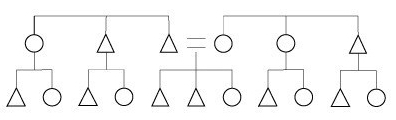
The diagrams are drawn in relation to the Ego, or self; in the diagram above the Ego is the triangle right below the marriage symbol (=). The triangles represent males, circles females. The level adjacent to the Ego would be siblings and cousins, in English. The level above represents parents, aunts, and uncles. Below, we will show the basic kinship classification systems, with diagrams and explanations of what each system is. Each different letter in the diagram represents a different term. Diagrams and short descriptions of each system are shown below.
Six Basic Systems
Sudanese
The Sudanese system is the most complicated of the six as each relative has a specific, distinct term.
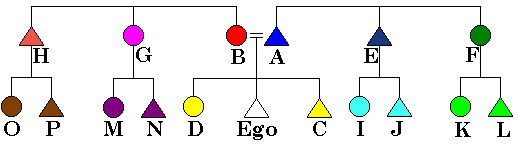
Hawaiian
The Hawaiian system is the least descriptive, where terms for brother and male cousin are the same, and sister and female cousin are the same, father and uncle are the same, and mother and aunt are the same.
Example: Hawaiian, Malayo-Polynesian languages
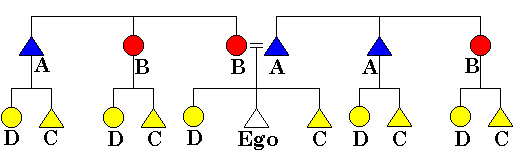
Eskimo
The Eskimo system has no distinction between terms for mother’s and father’s relatives.
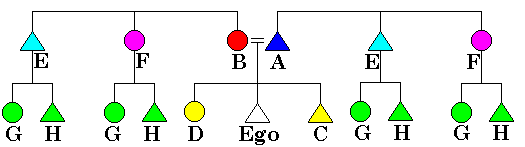
Iroquois
The Iroquois system follows a principle known as bifurcate merging, additionally mother’s and father’s relatives are distinct.
Examples: South Indian languages, Dravidian languages
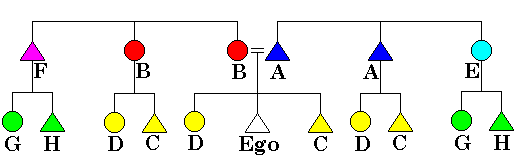
Omaha
The Omaha system is similar to the Iroquois, but a bit more complex.
Examples: Igbo, Mapuche
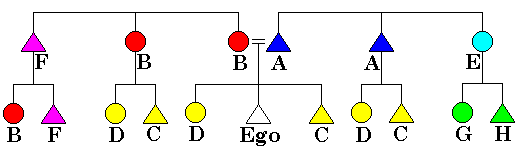
Crow
The Crow system is a mirror image of the Omaha.
Examples: Hopi, Navajo
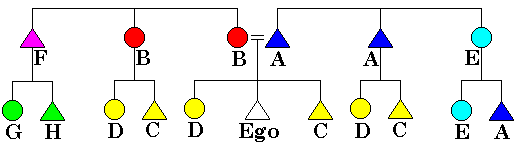
Learn more in detail about kinship classification systems by going to the site linked in the citation below.
Move on to English Kinship Terms.
Citations
Schwimmer, Brian. “Systematic Kinship Terminologies.” Kinship and Social Organization , Jan. 2001, https://www.umanitoba.ca/faculties/arts/anthropology/tutor/kinterms/termsys.html
 Kinship Terms in Various Languages