The German kinship system, being part of the Eskimo group of kinship systems together with English, is very similar in most aspects to the English system: The terms describing mother’s and father’s side of the family tree are not distinct from one another and the terms in both languages also all have a markedly similar root.
“Cousin” and “Vetter”
Here we have a case in which two kinship terms describe the same relationship, this being a male cousin of the speaker. The coexistence of these two words has historical roots, with “Vetter” originally being part of a larger and more complex group of kinship terms detailing extended family that can be traced back to ancient Germanic tribe societies. However, towards the late feudal period, these terms became more and more meaningless, as they lost their purpose of facilitating the application of inheritance laws that no longer were in place, leading to “Vetter” being used for any type of extended family members which led to confusion.
The term “Cousin”, along with the terms “Onkel” (uncle) and “Tante” (aunt) was then imported from French and widely adapted by especially rising middle classes as they saw it as a sign of rising status. The remainders of the old kinship system were then gradually pushed out by these new terms over the course of centuries, “Vetter” staying as the only real exception (it is notable though that its female form, “Base”, was on the other hand completely replaced by “Cousine”).
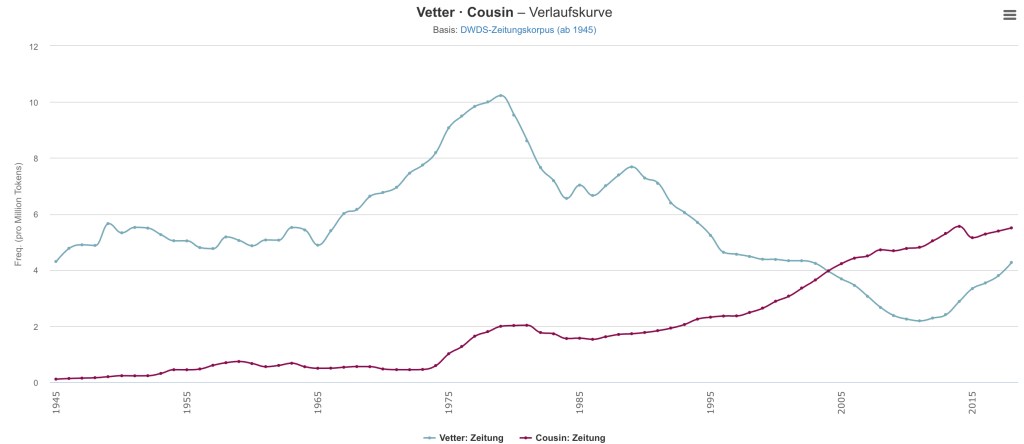
Today, both forms are used, although “Cousin” much more than “Vetter”. This is due to many Germans seeing the term as outdated and therefore not fit for daily usage. It also is not taught to most L2 learners of German for the same reason and perhaps also to avoid confusion. There still are however a number of people who use the term, interestingly not constrained by region though more so through age. As shown in the graph, “Cousin” only overtook “Vetter” in 2004 in newspaper usage, a fact that shows that the term is still widely seen as usable by official sources.
“Bruder” – Between Meme and Seriousness in Fictive Kinship
The use of the kinship term “brother” to show a spiritual connection to a close friend or member of the same group is also existent among German speakers, however there is a difference in how serious this usage is: While especially among immigrant communities of Eastern European or Arab/Turkish origin, it actually is used in the same way as in the English speaking world, denoting a deeper connection with the interlocutor and showing a type of affection for him, among the broader youth, in the past few years, “Bruder” has become more or less meme-ified.
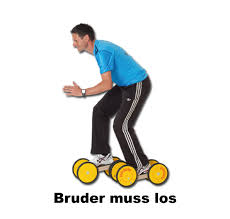
Although as with any meme – especially one as orally transmitted as this one –, its origin is hard to find, the first definite origin is the image-based meme “Bruder muss los” (“Brother, gotta go”, in meaning very similar to the “Aight, imma head out” meme) popularized on the German subreddit r/ich_iel in the August of 2018. With the popularization of this image, many variations of the phrase were invented, always centering around “Bruder” as the beginning of the phrase. This then lead to an interesting dynamic around “Bruder” being used as a phrase in addressing a friend with a certain ironic tinge to it.
On the other hand, as can be very prominently observed in German hip-hop, “Bruder”, or sometimes the Russian “Bratan” still denotes a real connection with a friend for many speakers. Overall, these different usages reflect the varieties of speech and cultures within the German speaking community and it would be interesting to see how both develop in the next few years.
Move on to Korean Kinship Terms.
Citations
Von Polenz, Peter. Deutsche Sprachgeschichte Vom Spätmittelalter Bis Zur Gegenwart. De Gruyter, 1999.
“Digitales Wörterbuch Der Deutschen Sprache.” DWDS, http://www.dwds.de/r/plot?view=1&corpus=dta%2Bdwds&norm=date%2Bclass&smooth=spline&genres=0&grand=1&slice=10&prune=0&window=3&wbase=0&logavg=0&logscale=0&xrange=1600%3A2000&q1=Cousine%2B&q2=Vetter&q3=Cousin.
“Digitales Wörterbuch Der Deutschen Sprache.” DWDS, http://www.dwds.de/r/plot?view=1&corpus=zeitungen&norm=date%2Bclass&smooth=spline&genres=0&grand=1&slice=1&prune=0&window=3&wbase=0&logavg=0&logscale=0&xrange=1945%3A2018&q1=Vetter&q2=Cousin.
Maciej, Martin. “Bruder Muss Los: Wo Es Herkommt, Memes Und Sprüche.” GIGA, GIGA.de, 25 Jan. 2019, http://www.giga.de/extra/netzkultur/specials/bruder-muss-los-die-besten-memes-und-sprueche-und-wo-es-herkommt/.
Maciej, Martin. “„Bratan’: Was Heißt Das Übersetzt?” GIGA, GIGA.de, 22 June 2018, http://www.giga.de/extra/netzkultur/specials/bratan-was-heisst-das-uebersetzt/.
 Kinship Terms in Various Languages