Overview
The English language follows an Eskimo kinship system, where there is no difference in naming between mother’s relatives and father’s relatives. This system signifies that there is a strong emphasis on the nuclear family over extended kin.
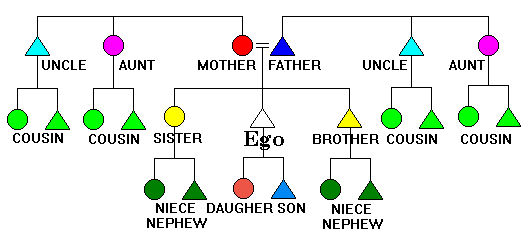
As shown above, the English classification system distinguishes mainly in generation and gender. For example, the ego’s siblings, they are called “brother” and “sister,” therefore the only distinction is in gender. “Cousin” is the only term in English that is not distinguished based on gender.
“Third Cousin Twice Removed“
What does this phrase mean? In English, terms exist to differentiate between generation in addition to gender.
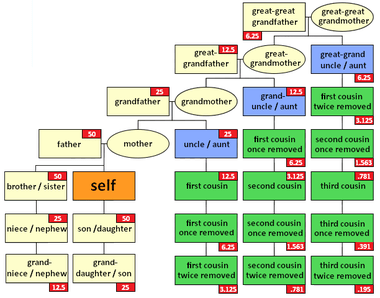
The ordinal numbers, such as first, second, and third, describe distance generationally. The ego’s “first cousin” is someone who has one set of grandparents that are the same; for example, your mother’s sister’s son would be your first cousin. Simple enough? Well it begins to get more complicated, as a second cousin will have one set of great-grandparents in common. Third cousin will have one set of great-great-grandparents being the same, and so on.
What’s the deal with the term “once removed”? Let’s start with the easiest to explain: first cousin once removed. The numeral adverb “once” refers to the number of generations separate from the first cousin, and the direction of this “removal” does not matter. Therefore the first cousin once removed is your first cousin’s child. Same applies for second/third cousins. Moving up a generation, your mother’s first cousin will be called your first cousin once removed, and same with your mother’s second cousin, and so on. Your grandmother’s cousin will be your first cousin twice removed.
While complex terms are complex, they are used for people who are barely related to you. Your third cousin twice removed only shares a mere 0.195% of your DNA, and they are related to your great-great grandparents six generations down. Additionally, it’s unlikely that you and your third cousin twice removed will ever meet, as they’ll be much younger than you and your genealogical distance from them is not close.
Read this article to learn more specifics about cousinhood–– Counting Cousins: How to Calculate Cousinhood
Fictive Kinship Examples
“Aunt” and “Uncle”:
Traditionally, the terms “aunt” and “uncle” are used for your mother or father’s siblings and their spouses, shown in the kinship diagram at the top of the page. However, these terms have become used for people that lack consanguineal/affinal ties.
Godparents: One of the most common uses of fictive kinship is godparenthood. Traditionally, godparents are a pair of people who sponsor someone’s admission into Christianity, usually chosen by the parents if the one being admitted is a baby. Godparents can also be chosen secularly, as a strong role model for a child while they grow up. One’s godparents can be related to them through blood (aunts and uncles are commonly chosen), but it is also common to have godparents who are simply friends. It is quite uncommon to call godparents “Godmother Carol” and “Godfather Bob”; most commonly, godparents are called “Aunt” and “Uncle,” even if they are not one’s true aunt/uncle. Depending on age, traditional kinship terms like cousin and brother could be used to refer to godparents too. Calling godparents by these kinship terms in English signifies that godparenthood is an important relationship, a relationship that equates non-blood related friends to blood relatives.
Friends: As mentioned above, the parents’ friends can be called their child’s godparent, and the child will refer to them as aunt and uncle. Furthermore, it is common for one’s parents’ friends to be called one’s aunt and uncle, even if they are not the child’s godparents. As these close friends are “like family,” it is fitting for them to be called aunts and uncles.
Calling non-blood relatives aunt and uncle can also be seen as a form of respect from the younger child. The child values these people who are often present around them. Consequently, the children of those called aunt and uncle may be referred to as cousins by the child.
Move on to German Kinship Terms.
Citations
Grassullo, Stephanie, editor. “Your Guide to Picking Godparents: What They Do and How to Choose.” The Bump, Feb. 2019, http://www.thebump.com/a/what-is-a-godparent#1.
Haddad, Diane. “Counting Cousins: How to Calculate Cousinhood.” Family Tree Magazine, July-Aug. 2017, http://www.familytreemagazine.com/premium/how-to-calculate-cousinhood/.
Live Science Staff. “What’s a Second Cousin vs. a First Cousin Once-Removed?” LiveScience, 14 Sept. 2012, http://www.livescience.com/32121-whats-a-second-cousin-vs-a-first-cousin-once-removed.html.
Schwimmer, Brian. “English Kin Terms.” Kinship and Social Organization, Aug. 1998, http://www.umanitoba.ca/faculties/arts/anthropology/tutor/kinterms/english.html.
—. “Systematic Kinship Terminologies.” Kinship and Social Organization, Jan. 2001, http://www.umanitoba.ca/faculties/arts/anthropology/tutor/kinterms/termsys.html.
Wagner, Richard A. “Fictive Kinship.” Marriage and Family Encyclopedia, 1995, family.jrank.org/pages/630/Fictive-Kinship.html.
 Kinship Terms in Various Languages