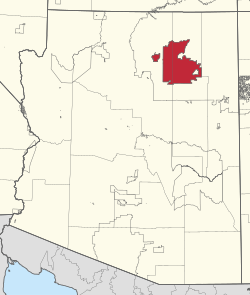
Hopi is a Uto-Aztecan language spoken in the southwest United States, specifically on the Hopi reservation in Arizona, marked below in red.
First, here are a few important things to know about Hopi culture:
- They are a matrilineal society, which means they trace lineage through the mothers of a clan;
- Similarly, they are a matrilocal society, which means after marriage, a husband lives in his wife’s household;
- Clans are made up of various blood-related families, and their members typically live together in large apartment-style homes called pueblos; this means that clan members are constantly very close in proximity, whether or not they are related by blood.
Second, here are some tidbits about the Hopi language:
- It has only 6,075 speakers.
- There are three (3) main dialects, called First Mesa, Second Mesa, and Third Mesa; the data on this page represents the Third Mesa dialect.
- The Hopi community tends to prefer privacy from researchers, so it is less documented than more prevalent languages.
Hopi Kinship
The diagram below shows a tree of Hopi kinship terms, where triangles (∆) represent males and circles (O) represent females. The Ego (person whose family it is) uses the same term to refer to family members represented by same-colored shapes. The Hopi use a Crow Kinship System.
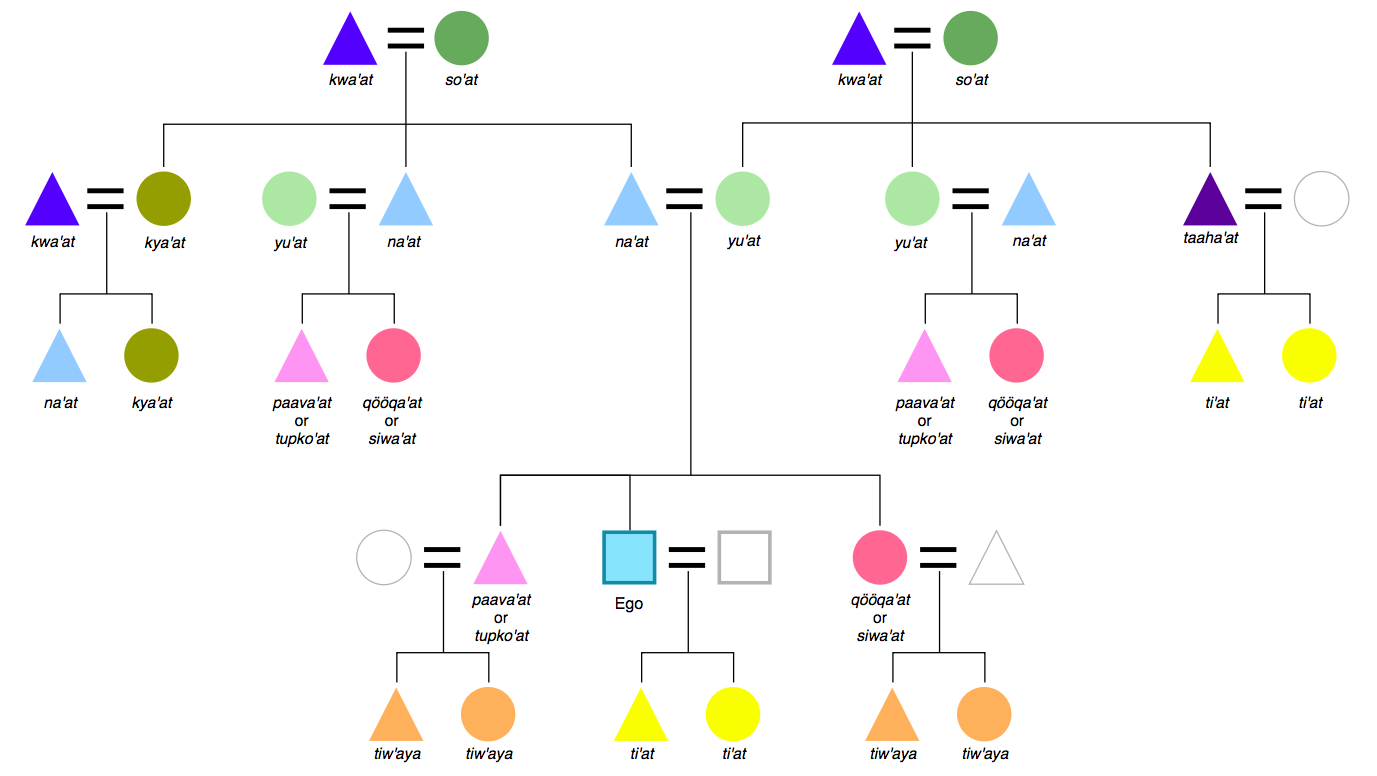
Based on the diagram, we can see that the term na’at is used to refer to various male family members, including one’s father, one’s paternal uncle, and the son of one’s paternal aunt. Similarly, anyone married to na’at is yu’at. Another characteristic of Hopi is that there are distinct words for one’s older brother, one’s younger brother, one’s older sister, and one’s younger sister—and these terms also refer to the children of one’s paternal uncle or one’s maternal aunt. (Note that when I refer to aunts and uncles, I am speaking only of one’s parents’ siblings, not affinal kin.)
Hopi Fictive Kinship
The following terms can be used to reference consanguineal kin, as well as various people who do not share a blood relation to the speaker:
- na’at
- yu’at
- paava’at
- tupko’at
- qööqa’at
- siwa’at
- ti’at
- tiw’aya
- taaha’at
- kya’at
- kwa’at
- so’at
You may notice (!) that every consanguineal kinship term is included on this list. Hmm…
To clarify, each of these terms cannot be used interchangeably with the others; there is a systematic explanation for which members of a clan may be referred to by which term, represented by the chart below.
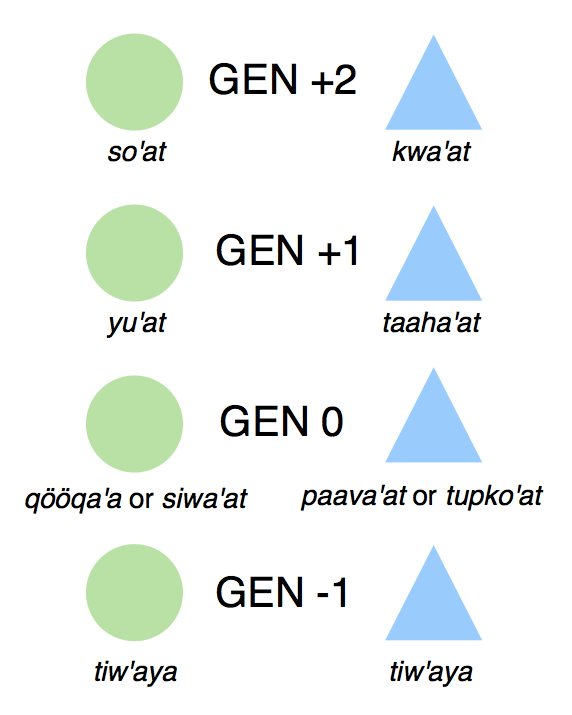
Again, circles (O) represent female clan members, and triangles (∆) represent males. The four rows in the chart denote generations of people; members in the topmost level are in the same generation as the Ego’s grandparents while members in the bottommost level belong to the same generation as the Ego’s children. For males and females in the Ego’s generation, the older-younger distinction still remains.
Perhaps the most interesting point this chart makes is the use of the collateral terms taaha’at ‘maternal uncle’ and tiw’aya ‘niece/nephew’ to refer to clan members where you might expect to find the lateral terms na’at ‘father’ and ti’at ‘son/daughter’. Why is this the case? Since the Hopi are a matrilineal society, they build their fictive kinship terms around the mother’s family. Therefore, any man one generation older may be referred to as one’s maternal uncle instead of one’s father.
“Wait,” you say, “you claimed earlier that every consanguineal term has a fictive counterpart. Then where do na’at, kya’at, and ti’at come into play?”
The fictive equivalents of these three kinship terms are harder to explain, but they are still used to identify clan members not related to the speaker by blood. The first two—na’at ‘one’s father’ and kya’at ‘one’s paternal aunt’—specifically refer to people not in one’s own clan, but rather in one’s father’s clan if it is different from the speaker’s. However, generally, the Hopi practice endogamous marriage, meaning they tend to marry people within their own clan. This ensures that a single clan is shared by father and children, largely reducing—but not eliminating—the need for such terms. Ti’at ‘one’s child’ may be used by male speakers to refer to the son or daughter of another male in his clan. For these terms, further study would largely benefit our understanding of their proper fictive use.
So what’s the point of all of this? What does it tell us about the Hopi people?
Well, we can take all of this to mean that within the Hopi community, being a member of one’s clan and being a member of one’s blood-related family are essentially regarded as having the same worth. A strong example of when language reflects a culture’s values, it also reflects the emphasis placed on society as a collective, typical among indigenous groups of North America. Basically, your entire community is your family—according to native speakers of Hopi.
Hopi Kinship Morphology
Another thing to mention concerning the prevalent use of fictive kinship terms in Hopi is affixation. So far, the specific examples identified have been presented in their third-person possessor, singular, nominative form. In English, we show possession through extra words (Think my father or Sue’s father), demonstrate singular vs. plural nouns with a suffix, and generally do not inflect nouns with a nominative case, which denotes that a noun is the subject of the sentence. Hopi is different from English in that its kinship terms—and possibly all nouns, although this is outside our topic—must be inflected based on each of these three aspects.
For example, na’at can be translated as one’s father, among other consanguineal kinship terms. However, as is the case with most other terms on the list, there are many different inflections of the word, which reflect number, possession, and case. Below is a chart taken from Hopi Dictionary / Hopìikwa Lavàytutuveni (1998), published by the University of Arizona Press, that shows how to properly inflect na’at. Note that the morpheme *na contains the meaning father, but it cannot stand alone.
| nominative singular | nominative plural | accusative singular | accusative plural | |
| first-person singular (e.g., my) | ina | inam | inay | inamuy |
| first-person plural (e.g., our) | itana | itanam | itanay | itanamuy |
| second-person singular (e.g., your) | una | unam | unay | unamuy |
| second-person plural (e.g., your) | umuna | umunam | umunay | umunamuy |
| subject = possessor | — | — | nay | namuy |
| third-person singular (e.g., her) | na’at | namat | nayat | namuy |
| third-person plural (e.g., their) | na’am | namat | náyamuy | námuyatuy |
This chart is great and all, but what aspect of kinship term inflection matters in the grand scheme of things?
Specifically, let’s discuss the affixes that show possession. From a personal perspective, I believe forming a single word from the root of the noun and its possessor inherently emphasizes the connection shared between kin, whether fictive or not. A man cannot just be a father in Hopi, but rather he must be someone’s father. This shows how interconnected Hopi communities are, as well as the value they place on acknowledging the fact that kinship goes two ways. If there is a father, there must be a son or daughter.
Also, when discussing relatives, speakers rarely use the first-person singular possessor prefix, instead opting for its plural equivalent. That is, they tend to use our where English speakers might expect to hear my. Doing otherwise could imply that a hearer does not belong in the community and may be interpreted as an insult. Below is an excerpt from an article written by anthropologist Mischa Titiev, in which he provides an example of this type of miscommunication.
Once, while I was residing in the house of Don Talayesva at Old Oraibi, two of his sisters, who were also my sisters by adoption, happened to see a snapshot of my own brother’s wife.
“Who’s that?” they asked.
“My sister-in-law (imû’wi)”, I answered casually.
“Our sister-in-law (itamû’wi)?” they inquired.
“No”, I replied off-hand, “My sister-in-law (imû’wi)”.
“All right”, they snapped back in unison, “If we can’t call her our sister-in-law, then you can’t call Don’s wife your sister-in-law”.
Mischa Titiev, “The Hopi Use of Kinship Terms for Expressing Sociocultural Values” (1967)
This instance illustrates quite well the cultural significance of denoting possession in kinship terms. Along with the specific method of showing possession, its actual practice in real-world contexts demonstrates the importance Hopi places on the community as a collective society for everyone to belong. As a result, kinship is reflected in Hopi through implicature—when the kinship in question is between the speaker and the hearer, for example—as well as the direct usage of terms.
Citations
Hill, Kenneth C, et al., editors. Hopi Dictionary / Hopìikwa Lavàytutuveni: a Hopi-English Dictionary of the Third Mesa Dialect. University of Arizona Press, 1998.
Schwimmer, Brian. “Hopi Domestic Organization.” Hopi Matrilocal Households, University of Manitoba, Oct. 2003, www.umanitoba.ca/faculties/arts/anthropology/tutor/residence/hopi.html.
Titiev, Mischa. “The Hopi Use of Kinship Terms for Expressing Sociocultural Values.” Anthropological Linguistics, vol. 9, no. 5, May 1967, pp. 44–49., doi:https://www.jstor.org/stable/30029355.
 Kinship Terms in Various Languages